About Us
Founding, activities and goals of the Association
Founded in 1904 through the efforts of Dr Vojislav Kujundžić, the Oganj Society has promoted the culture of cremation for more than a century. Our mission is to protect the environment and prevent the spread of cemeteries, so that we leave a sustainable and dignified world to our descendants.
History
The cremation movement in the world and in Serbia
More than a century of advocating a dignified, healthy and sustainable way of burial, from the first fires of antiquity to today's Association.
- 1904Founding assembly of the Oganj Society
- 1934The newspaper Oganj is launched
- 1964First crematorium in Yugoslavia, Novo groblje
- 1980Crematorium at Lešće opens
- 1987The Solidarity Fund is founded
- 1995The Society becomes the Oganj Cremation Association
From fire to catacombs
It is indisputably proven that the burning of the dead reaches far into the past, beginning with the discovery of fire.
In pre-Christian times, the dead were burned in Rome. It is known that Caesar, Augustus, Nero, Pompey, Tiberius, Tacitus, Pliny and others were cremated. Urns have also been found in Roman graves in our country. This testifies not only to the burning of the dead, but also to the way their ashes were kept in special vessels. The ancient Slavs, as well as the South Slavs, burned their dead and buried the ashes in the ground. Members of the first Christian communities adopted the custom of burying the dead and placed them in underground passages – catacombs. In resistance to the old pagan faith and old customs, Christians declared cremation a pagan custom. From then on, burial in the ground was the only possible way of burial for every Christian.
Cemeteries and the health crisis
Over the centuries, burials in the ground created dangerous hygiene and urban planning problems. The situation worsened especially when burial outside church cemeteries was banned. Since those cemeteries were limited in space, over time the dead were buried one on top of another, without waiting the passage of time that hygiene required. Efforts by progressive circles to arrange public cemeteries for health and other reasons remained unrealised for a long time because of conservative views. Paris received its first public cemetery in 1801, London in 1852, and Belgrade in 1850 at Banjica.
The unbearable spread of disease and infection contributed to the revival of the idea of burning the dead. The first bearers and advocates of that idea were doctors and scientists.
Renaudot and the birth of the idea
The originator of the idea of cremating the dead in the modern era was Dr Théophraste Renaudot, a French physician, historian and encyclopaedist, who in 1642, in one of his lectures held in Paris, said:
A person to whom immortality belongs deserves fire – the symbol of eternity – more than earth. I give preference to fire; it is the sign of immortality.
Florence, 1869: the official beginning of the movement
Officially, the cremation movement was founded in 1869 in Florence at the International Congress of Medicine, when Prof. Fernando Coletti and Dr Paolo Castiglioni proposed, and the congress participants unanimously adopted, the resolution:
The Congress expresses the wish that all possible means be used to secure legal possibilities – in the interest of hygiene – for the present system of burial in the earth to be replaced by the cremation of the dead.
This resolution marks the official beginning of a new era in the struggle for the modern burial of the dead. It can also be considered the beginning of the environmental movement in the world, because it shows a maturing awareness of the need to preserve the environment.
Serbia at the turn of the century
With the gaining of independence in 1878, Serbia began a rapid economic and social transformation. Serbia sought to develop in line with European states. At that time, within Serbian civil society, a new young bourgeois class was emerging, one that had grown up in a free country and been educated in the West. The driving forces of this generation of Serbs were raising the cultural level of the Serbian people, rejecting outdated inherited habits and adapting to scientific and civilisational progress in the world. However, despite abandoning traditional cultural patterns, the modernisation of Serbian culture at the beginning of the 20th century had a distinctly national character. General European standards in social relations, civic culture, science, literature and art gave the new era features of cosmopolitanism and the universality of fashionable style, but nowhere were positive national characteristics suppressed or erased.
The founding of the Oganj Society
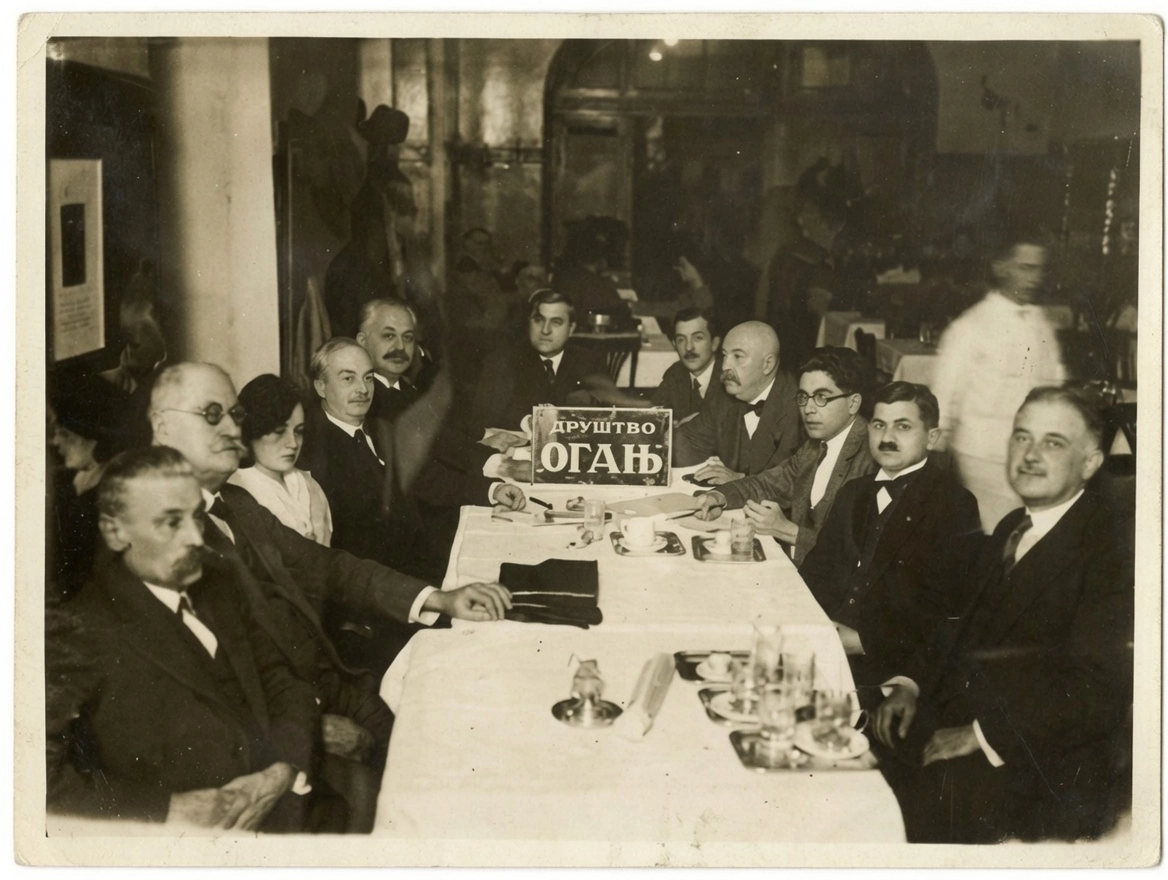
On 20 December 1904 the initiative committee held the founding assembly of the Oganj Society.
Although at the time the cremation movement seemed to the civil and church authorities to be the pastime of idle people, it progressed and gained more and more supporters, and the Oganj Society more and more members. The entire promotional activity was carried out through lectures held across Serbia by Dr Kujundžić and other members of the Board together with guests from abroad, and it gained particular momentum with the launch of the newspaper Oganj, which began publication on 30 July 1934, on the feast of St Mary of the Fire, the Society's patron saint established in 1930. By the end of 1936 the Society had subcommittees in Zemun, Pančevo, Vršac, Novi Sad, Zrenjanin and Subotica, and numerous donor members from Niš, Leskovac, Požarevac and Sombor.
From the very beginning the founders of the Oganj Society cooperated with similar societies in Europe, which was made easier by personal acquaintances gained during studies abroad. Thanks to contacts with cremation societies from Vienna and Prague, and after the First World War also from Czechoslovakia, France, England, the Netherlands, Sweden and Luxembourg, specialist literature, books and brochures translated into Serbian, as well as films and photographs, arrived in Belgrade. That material spoke about the advantages of cremation over classic burial in terms of preserving public health and preserving land for agriculture and for the construction of residential and other buildings, and was used in lectures held at home and abroad. Thanks to this cooperation, Dr Vojislav Kujundžić received high recognition and was elected an honorary member of the German Union of Cremation Societies in 1934.
The dispute with the Church
The Society's promotional activity provoked a reaction from church circles in the country, and a polemic developed in the newspaper Politika between representatives of the Orthodox and Catholic churches on one side and supporters of the cremation movement on the other. The polemic was ended by Bishop Stjepan Zagorac of the Croatian Old Catholic Church with an article in which he quoted the words of his colleague, Old Catholic Bishop Schindler:
The divine spark that germinates in us, which is spirit of spirit and life of God's life, our immortal soul, can neither be burned nor buried. The soul rises, when it leaves the earthly body, above the grave and above the flame into higher spheres and returns to God, the eternal source of all life. What happens to the body from the standpoint of faith is entirely irrelevant; it must become dust and ashes by an irresistible natural law, whether after a long process of decay in the earth and grave, or after a few hours in a fiery grave through the power of fire that cleanses and enlightens – a handful of ashes here as there.
Finally, in 1963, the Roman Catholic Church officially approved cremation as a way of burial for its believers. The Orthodox Church, despite numerous contacts and agreements between Dr Vojislav Kujundžić and other members of the Oganj Society board and Patriarch Dimitrije, Patriarch Varnava and Patriarch Gavrilo Dožić, and although there were among its dignitaries those who understood the humane and health aspects of this idea, did not officially accept cremation.
War years and rebuilding
During and after the Second World War, and after the death of Dr Kujundžić in 1946, the work of the Oganj Society faded for a time and was revived in 1954 on the initiative of Grgur Mitrović, a retired colonel, who was elected president of the Society at its first assembly. The new board and members continued with promotion and pressed city and state authorities to build a crematorium in Belgrade and to provide space at the Novo groblje cemetery for a Garden of Remembrance and the construction of a columbarium and rosarium for laying urns.
Finally, in 1964, the long-standing efforts of Oganj's founders and their successors bore fruit and the first crematorium in Yugoslavia was built, at the Novo groblje cemetery in Belgrade. It was designed by architects Spasoje Jovanović and Ljubomir Profilović.
The Oganj Society renewed earlier connections and founded committees across the country whose members were cremated in Belgrade.
The new crematorium at Lešće
A great contribution to the Society's work at that time was made by board member Mr Pavle Blažić, who from 1970 was also director of Belgrade cemeteries. At the request of believers – members of the Oganj Society – he visited Patriarch German in 1973, renewing the conversations Dr Kujundžić had held with his predecessors about allowing religious rites during farewells before cremation. The Patriarch showed understanding for believers who choose cremation for humane reasons, to preserve a healthy environment for the future and to stop the spread of cemeteries at the expense of agricultural and building land. He pointed out that this was a historic moment, as he would take on the responsibility of advocating before church forums that the church stand on the side of cremation.
However, to this day the Holy Synod of the Orthodox Church has not officially approved cremation, although since 1973 memorial services have been held during farewells before cremation.
The Solidarity Fund and the Association today
The members and governing bodies of the Oganj Association today believe that this too is a matter of time, and that the dignitaries of the Orthodox Church, just as they accepted and approved organ donation as a humane and useful act, will also accept cremation as the choice of people who, precisely out of Christian love for their neighbours and the future of our children, opt for this way of burial. In December 1987 the Solidarity Fund was founded within the Society, through which members secure the complete costs and organisation of a funeral in their lifetime.
Interest in joining the Fund was enormous. By the end of 1990 more than 6,000 members had joined, and to this day more than 14,000.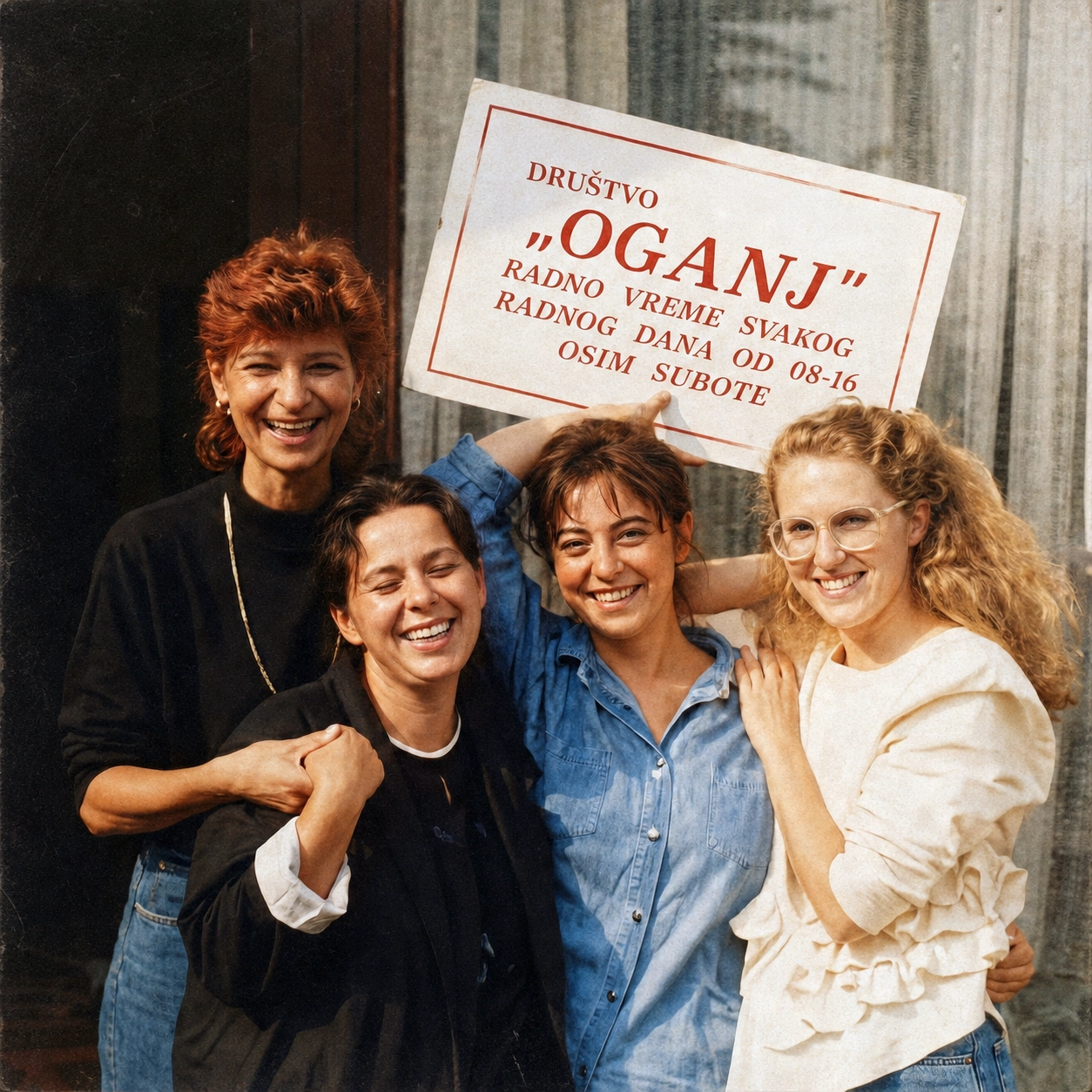
In the period from 1991 to today, the Society and the Fund, like the whole country, went through a difficult period of wars, sanctions and general economic crisis. The hardest time was during hyperinflation. Through the joint efforts of the Presidency and the professional service, the Oganj Society – which officially changed its name to the Oganj Cremation Association in 1995 – and the Fund were preserved and have regularly fulfilled their obligations to members throughout their existence.